GGMA Markets Briefing: The US Ten-Year Yield Passes 5% for the First Time Since 2007 on the Eve of the Fed Decision
Main News
Good morning,
I hope all is well.
Here is a brief summary of today’s Markets Briefing: The US Ten-Year Yield Passes 5% for the First Time Since 2007 on the Eve of the Fed Decision
· The US ten-year Treasury yield rose to its highest level since 2007, a day before a Federal Reserve decision where a quarter-point increase is close to fully priced.
· Oil rose again with the Saudi pipeline still shut, after Iran said a supertanker exploded on naval mines in the Strait of Hormuz and warned insurers away from a list of vessels.
· British payrolls fell for a fifth month and vacancies reached a five-year low, two days before a Bank of England decision that the oil price has made harder.
· Chinese factories beat expectations on export demand while retail sales missed and unemployment rose, widening the divide that will decide whether Beijing adds stimulus this month.
· Bank shares fell after Bank of America told a conference that trading revenue would be flat and investment-banking fees would come in below what analysts expected.
· The Bank of Japan is expected to raise rates on Friday in the shortest interval since it left negative rates, with the vote count the thing to watch.
Today’s Macro Roadmap: German ZEW at 11:00 CET, US Empire manufacturing at 14:30, the twenty-year reopening at 19:00. Four ECB speakers through the day. The Fed decides Wednesday, the Bank of England Thursday, the Bank of Japan Friday.
Full Article:
GGMA Markets Briefing: The US Ten-Year Yield Passes 5% for the First Time Since 2007 on the Eve of the Fed Decision
The US ten-year Treasury yield rose to its highest level since 2007 and oil extended its advance, a day before a Federal Reserve decision the market now treats as settled (BBG). The ten-year yield rose 2.9 basis points to 5.02% and the two-year 1.4 basis points to 4.67%, while WTI rose 1.53% to $102.94 and Brent 1.39% to $107.15 (BBG) (News).
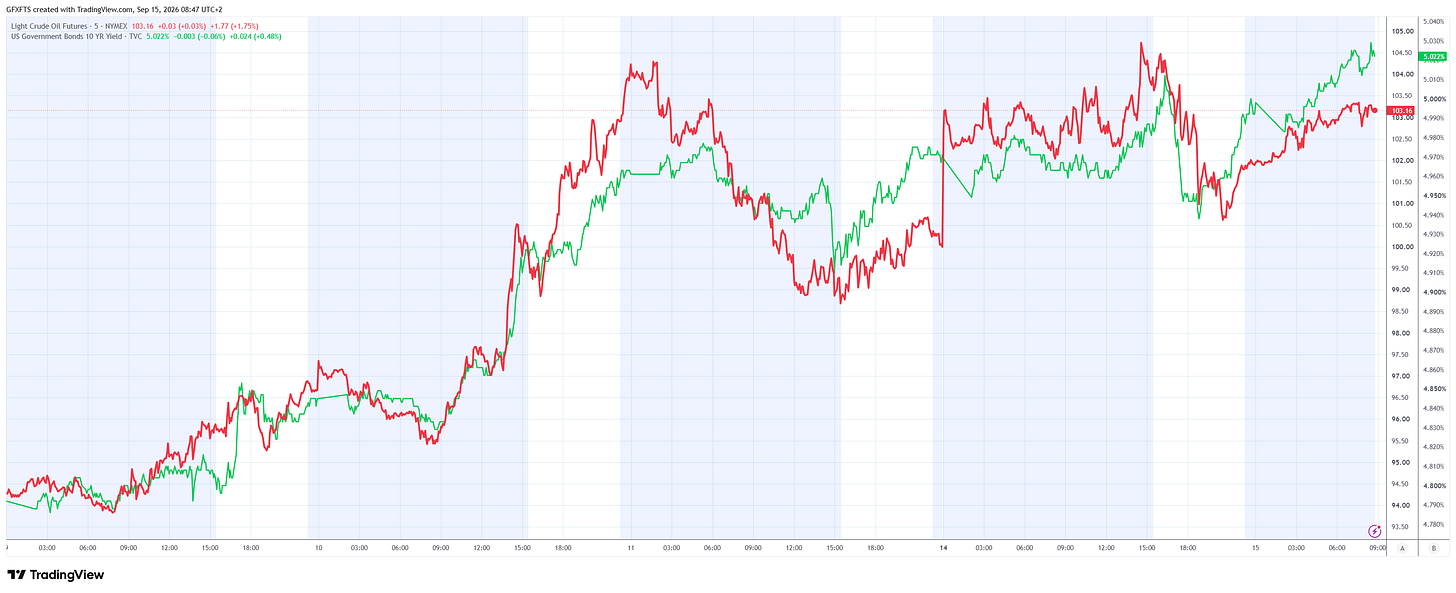
Bloomberg reports that the yield rose as much as four basis points on Tuesday, passing its 2023 peak, and that the latest leg followed the rise in oil as risks to Middle Eastern supply grew (BBG). “It would be very difficult for the Fed to leave rates unchanged this week without eroding its inflation-fighting credibility,” said Vail Hartman, a strategist at BMO Capital Markets, who added that the market is vulnerable both to an unexpected hold and to a dovish increase that brings a more patient message from the dot plot or the press conference (BBG). Phoebe White, head of US rates strategy at UBS, said the scope for long-end yields to fall is limited while the real economy shows no weakness and structural demand for Treasuries, particularly from foreign official investors, is materially weaker than in 2007 (BBG).
In stocks, the ASX fell 0.86% to 8,673 and the Hang Seng 0.43% to 24,765, while the Nikkei rose 0.27% to 63,520 on a softer yen (BBG) (WSJ). Bloomberg reports that Asian shares fell 0.7% and that the broadest measure of global equities is heading for a fifth loss in six sessions (BBG). Banks were the sore point: Bank of America Chief Executive Brian Moynihan told a conference on Monday that trading revenue would be relatively flat against last year’s third quarter and that investment-banking fees would come in around $1.6 billion to $1.8 billion, below the roughly $2 billion analysts expected, and the shares fell as much as 6%, their biggest intraday drop since April last year (BBG). Goldman Sachs fell about 4% and Morgan Stanley 3.6% (BBG). Dean Curnutt of Macro Risk Advisors wrote to clients that rate rises will compress margins at companies that cannot pass costs through and told them to expect a pullback of eight to ten per cent, comparing the setup for the S&P 500 to 2018 (BBG). Dow futures fell 0.27% to 52,298, the Nasdaq 0.22% to 29,089.5, the S&P 500 0.21% to 7,609.25 and the Russell 2000 0.26% to 2,886.7, while Euro Stoxx 50 futures were little changed at 6,264 and FTSE futures fell 0.15% to 10,684 (BBG).
Regarding the Federal Reserve, which decides at 20:00 CET on Wednesday, Reuters reports that a fresh poll now has economists expecting a quarter-point increase to 3.75-4.00%, a reversal from a week ago, and that Bank of America analysts framed the choice for policymakers as hiking or risking a large bond spike (Reuters). Michael Feroli of JPMorgan said the chair’s repeated stern warnings on inflation risk institutional credibility without action to back them up, while calling it a closer call than the market implies (Reuters). Derek Holt of Scotiabank said hiking now is the wrong move but will happen anyway: “Chair Warsh has probably boxed himself in with his high deference to markets. If you don’t hike when it’s priced, then when?” (Reuters). At the European Central Bank, Executive Board member Isabel Schnabel said in Berlin that energy-price developments have been “quite concerning”, pointing to diesel as well as oil and to low European gas storage alongside competition with Asia for liquefied natural gas (BBG). Slovakia’s Peter Kazimir wrote that the Council will not waver when the evidence calls for action, and Lithuania’s Gediminas Simkus said he cannot rule out any specific meeting (BBG). At the Bank of England, which decides on Thursday, the August labour report landed weak: payrolled employees fell 26k against the 5k drop economists expected, and ONS reports vacancies fell to a five-year low of 702,000 while wage growth excluding bonuses held at 3.5% (LS). A slack labour market has eased most rate-setters’ fears of second-round effects, but Bloomberg writes that traders added to their bets after oil rose, pricing as many as five increases by the end of next year (BBG). At the Bank of Japan, which decides on Friday, the Wall Street Journal reports that a quarter-point increase would be the shortest interval between moves since the bank left negative rates in March 2024, and that the vote count is the signal to watch, because dissent from two board members appointed by Prime Minister Takaichi would read as government resistance to tightening (WSJ). For the Fed, markets price a 92% probability of a 25 basis point rate hike on Wednesday, and 52 basis points cumulatively by December. For the Bank of Japan, markets price a 99% probability of a 25 basis point rate hike on Friday, and 48 basis points cumulatively by December. For the Bank of England, markets price a 30% probability of a rate hike on Thursday, and 52 basis points cumulatively by December. For the ECB, markets price a 73% probability of a rate hike in October, and 39 basis points cumulatively by December. For the RBA, markets price a 78% probability of a rate hike on 29 September, and 39 basis points cumulatively by December. For the Bank of Canada, markets price a 74% probability of a rate hike in October, and 37 basis points cumulatively by December. For the RBNZ, markets price a 67% probability of a rate hike in October, and 38 basis points cumulatively by December.
In currencies, the dollar index rose 0.23% to 99.62 and gained against every Group-of-Ten peer, a day after its biggest jump in more than two months (BBG). The yen weakened 0.29% to 154.79 per dollar before Friday’s decision and the won was the weakest in Asia, down 0.82% at 1,358.97 (BBG) (WSJ). The euro eased 0.15% to 1.1532 and sterling 0.16% to 1.3477 (BBG). Bloomberg reports that the People’s Bank of China set a stronger reference rate for a fifth straight day and the longest such run since December 2025, with Christopher Wong of OCBC reading a mild policy-signalling element before the Xi-Trump summit on 24 September (BBG).
In government bonds, the selloff ran across the curve and into Asia, with the Japanese ten-year yield up 2.6 basis points to 3.04% and the thirty-year Treasury yield up 3.3 basis points to 5.38% (BBG) (BBG). Bloomberg reports that widening fiscal deficits, heavy issuance and borrowing to finance artificial-intelligence investment are prompting investors to demand more compensation for holding longer-dated debt (BBG). Zach Griffiths, head of investment-grade and macro strategy at CreditSights, said there are many underlying factors that make a sustained selloff in rates the path of least resistance for now, and that ten-year yields could rise toward 5.5%. Separately, the New York Fed said it will not buy Treasury bills for reserve-management purposes in the month to 14 October, a second straight pause, while still making about $15.6 billion of reinvestment purchases. Analysts say this signals confidence in funding markets and no shift in policy or balance-sheet strategy (BBG).
In commodities, gold fell 0.24% to $4,289.16 and the precious metals index 0.60% to 440.5813 as firmer rate expectations lifted the dollar (BBG). Bullion fell more than 1% in the previous session to a five-week low and is down more than 3% this month after trading far higher in late August (BBG). Iran’s Revolutionary Guard said a supertanker exploded and caught fire after striking naval mines while taking what it called a forbidden route south of the Strait of Hormuz, and Iran’s strait authority warned insurers, protection and indemnity clubs and classification societies against providing services to vessels on its list of violating ships (News). President Trump said on Monday that Ukraine and Russia had agreed to halt strikes on each other’s energy infrastructure, having blamed Kyiv’s attacks on Russian refineries for high diesel prices; President Zelenskyy replied that Ukraine is not confident Russia intends to adhere to any agreement and will stop only on a reciprocal basis, and the Kremlin has not commented (Politico). Copper eased 0.16% to 488.0146.
In other news, this article caught my eye: “ANZ CEO Warns of AI Risks, Job Cuts After Musk, Altman Alert” (BBG). The chief executive of an Australian bank told a summit in Sydney that the technology is creating risks at a much higher pace than its own builders expected and declined to rule out large-scale job cuts, while a rival told investors the same day that five agents across mortgages and consumer finance will free up tens of thousands of hours of banker capacity a year (BBG).
Data and the day ahead: China’s industrial production rose 5.2% from a year earlier in August against 4.8% expected and 4.5% in July, while retail sales rose 0.4% against 0.8% expected, fixed-asset investment fell 7.2% year to date and the surveyed jobless rate unexpectedly rose to 5.3% (BBG). The United Kingdom’s labour report was weak: payrolled employees fell 26k against 5k expected with July revised to a 19k decline, jobless claims rose 27.8k after a revised 11.8k fall, the claimant count rate rose to 4.4%, vacancies fell to 702,000 and average weekly earnings slowed to 3.9% as expected from a revised 4.2% (LS) (BBG). Germany’s wholesale prices rose 0.9% on the month and 6.8% from a year earlier after 5.3%, and Norway’s trade surplus widened to 100.4 billion (LS). Japan’s tertiary industry index rose 0.4% in July against 0.3% expected (LS). New Zealand’s retail card spending fell 0.9% after a revised 1.2% gain (LS). Chinese new-home prices fell 0.17% on the month and resale values 0.31%, with Bloomberg reporting that even the tier-one recovery is losing steam and that August’s figures came too early to reflect the property overhaul announced at the end of last month (BBG). Still to come: the German ZEW survey at 11:00 CET, Canadian existing home sales at 11:00, US Empire manufacturing at 14:30 and the twenty-year bond reopening at 19:00. European Central Bank speakers run through the day: Vujcic at 10:00, Moulin in Paris at 10:45, Escriva on the digital euro at 12:00 and Cipollone in Frankfurt at 16:00 CET. The Federal Reserve remains in its blackout before Wednesday’s decision at 20:00 CET, with the Bank of England on Thursday and the Bank of Japan on Friday (LS) (BBG).
Time Stamp: 15 September 2026, 08:10 CET